What Turo Fleet Metrics Should a Toll Dashboard Show?
A useful toll dashboard shows what needs attention, not just a total — the metrics that connect intake to recovery.
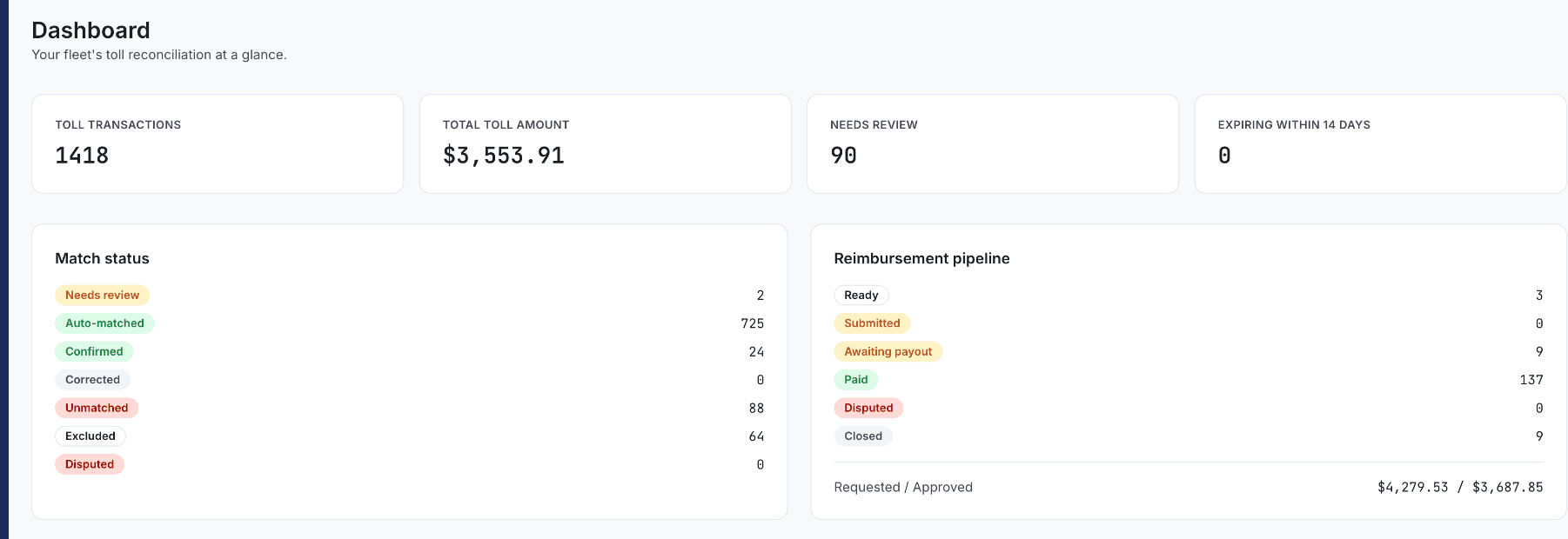
A useful dashboard tells an operator what needs attention — it doesn't just display a large total and call it done. The metrics that actually matter connect transaction intake, match quality, deadline risk, and reimbursement outcomes to each other, rather than presenting each one in isolation.
Intake and matching metrics
Intake: toll transaction count, total imported toll amount, date coverage by provider, and new/duplicate/rejected row counts. Matching: auto-matched, confirmed, corrected, needs review, unmatched, excluded, and disputed — a breakdown, not a single match-rate percentage that hides which category is actually growing.
Recovery, deadline, and ticket metrics
Recovery: ready to bill, submitted, awaiting payment, paid, disputed, closed, and requested-versus-approved-or-paid value. Deadline and ticket: cases expiring soon, overdue tickets, tickets due soon, and unpaid guest charges. Together these answer a more useful question than "how much did we import" — namely, how much of that is actually turning into recovered money, and what's at risk of not making it.
Every metric needs a drill-down path, and totals need honest boundaries
A "needs review" count without an actionable queue behind it is decoration, not a metric — every number on a dashboard should open the records that produced it. And imported toll amount is not the same thing as eligible, submitted, approved, or paid value; keep those stages visually and numerically separate rather than letting a large top-line total imply money that hasn't actually been recovered yet.
What good numbers actually look like
There's no universal healthy percentage, but a few patterns are worth watching: a needs-review rate climbing month over month usually means an upstream data problem (a provider format change, stale vehicle records), not more genuinely ambiguous tolls. An unmatched count that never shrinks even as new imports keep coming in usually means the same unresolved cases are sitting untouched rather than actually being worked. Both are dashboard-visible signals that something upstream needs attention, not just more review time.
Kenneth Elliott operates Elliottz Motors and has managed more than 1,000 Turo trips.