What Should Turo Toll-Reconciliation Software Include?
A practical checklist for evaluating toll software: import handling, matching, recovery tracking, and ticket processing.
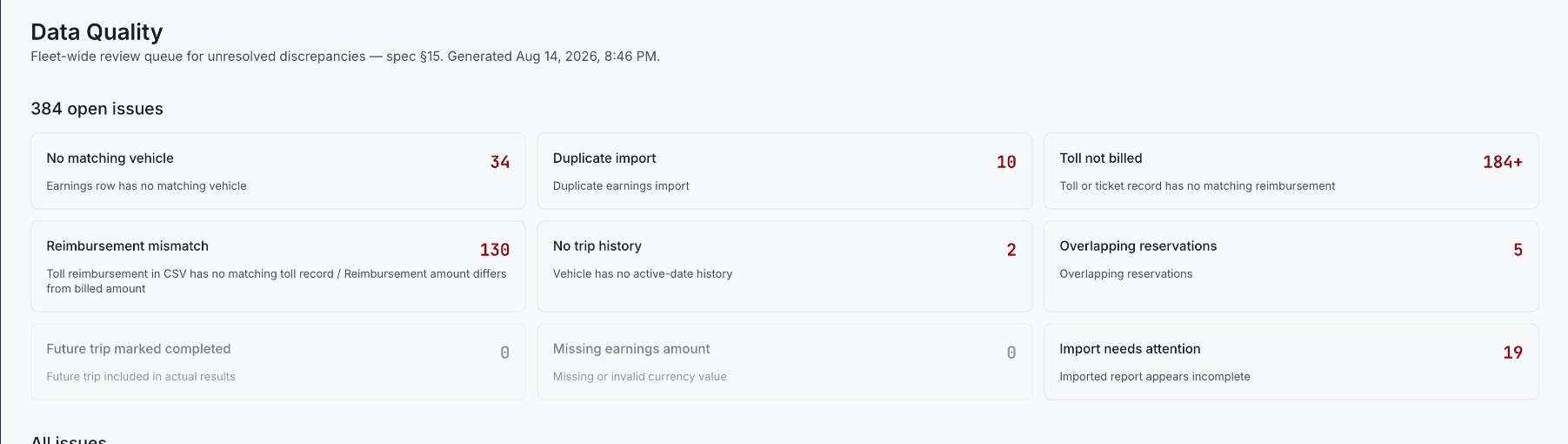
Good toll software should do more than place transactions in a table. It should preserve the source data, connect charges with reservation history, explain its own uncertainty instead of hiding it, support evidence, and keep the operator in control of anything ambiguous.
Data, import, and matching features
Data and import: CSV/Excel imports appropriate to your providers, saved column mappings, date/currency/plate/tag normalization, original-file retention, and idempotent imports with duplicate detection. Matching: plate and transponder matching, exact reservation time-window comparison, historical (not just current) plate and transponder assignments, confidence or exception reasons on every match, and manual review/correction that doesn't lose the original history.
Recovery, governance, and ticket features
Recovery: separate statuses for matched, ready to bill, submitted, paid, disputed, and closed, current deadline visibility, evidence/document linkage, and reporting that actually reconciles source charges to outcomes. Governance: roles, least-privilege access, audit history, record ownership, export rights, and data retention. Tickets: image/PDF upload, OCR extraction, field-level review, original-document preservation, due-date tracking, and the ability to connect a citation to the same vehicle and reservation data used for tolls.
Be precise about what "integration" actually means
Clarify whether a product imports files, connects to a toll agency, connects to Turo, prepares billing records, or actually submits invoices — these are genuinely different capabilities, and "integration" gets used loosely enough to blur them. Ask for a live demonstration rather than taking the word on its own.
Test with difficult records, not clean samples
Include back-to-back trips, moved tags, a repeated file, missing plates, a correction, a Toll-by-Plate notice, and one genuinely ambiguous citation — perfect sample data reveals almost nothing about how a product actually behaves. Kelviz is built around these same relationships; the plan comparison at Pricing shows exactly which governance features (role-based permissions, audit reports, API access) are included starting at which tier, rather than bundling everything into every plan.
Kenneth Elliott operates Elliottz Motors and has managed more than 1,000 Turo trips.